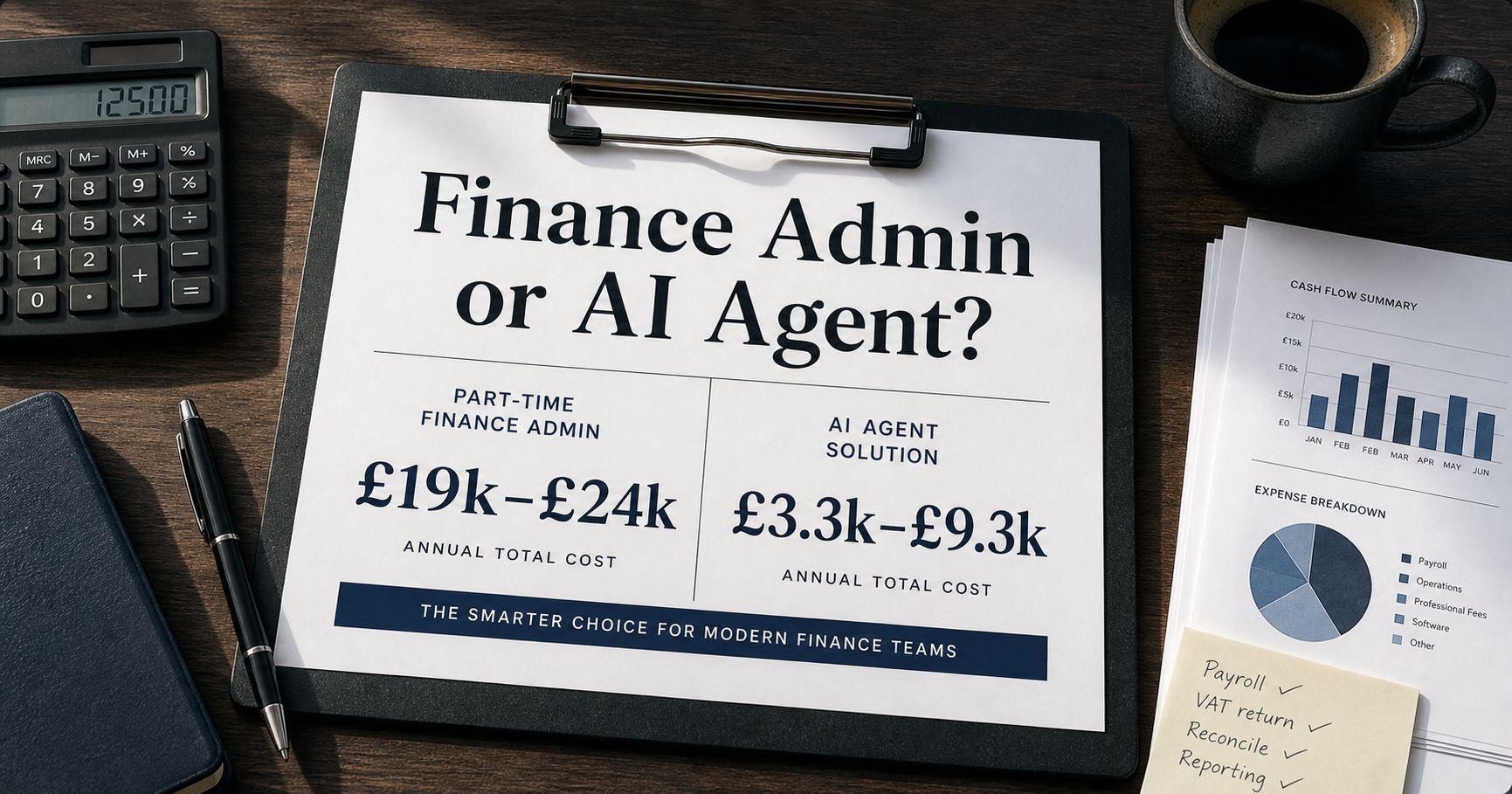
For most UK firms processing under 5,000 transactions per month, an AI agent costs 60-75% less than a part-time finance administrator and usually handles more volume without sick leave, annual leave, or handover risk. In most cases, the break-even point sits between 800 and 1,200 transactions a month.
That headline matters because many firms still frame this as a staffing decision. It is not just that. It is a throughput, governance, and error-risk decision as well.
What does a part-time finance admin actually cost a UK firm in 2026?
The base salary for a part-time finance administrator in the UK might look manageable at first glance. A 0.5 FTE hire often lands around £14,000-£16,000 a year.
That is not the real employer cost.
Once you add employer's National Insurance, pension contribution, paid leave, recruitment fees, onboarding time, software, and the inevitable dip in productivity while the person learns your way of working, the more realistic first-year cost is higher.
Part-time finance admin (0.5 FTE)
- Year 1 cost: £19,000-£24,000
- Year 2+ cost: £17,500-£21,000
- Best fit: relationship-heavy work, irregular processes, frequent edge cases
Scoped AI finance agent
- Year 1 cost: £3,300-£9,300
- Year 2+ cost: £1,800-£4,800
- Best fit: high-volume, repeatable finance admin with stable rules and clear exception review
Additional cost items for the human hire usually include:
- Recruitment: £1,500-£3,000
- Training and onboarding: 4-8 weeks at partial productivity
- Sick and holiday cover: 28 statutory leave days plus average sick leave in line with recent CIPD estimates
What does an AI agent cost to deploy and run?
A finance admin agent has two cost layers.
The first is setup. For a small or mid-sized UK firm, that usually lands between £1,500 and £4,500 depending on how many systems need connecting. Xero, QuickBooks, Sage, bank feeds, invoice capture, document ingestion, and approval logic all move the number.
The second is ongoing run cost. That is usually £150-£400 a month for API usage, orchestration tooling such as n8n or Make, and a small maintenance retainer.
Even at the upper end, the AI route is usually materially cheaper:
- 60% lower than a part-time admin in year 1
- 70-90% lower from year 2 onward
That does not mean it replaces every finance task. It means the economics are hard to ignore when the work is structured and repetitive.
What can each option actually handle?
This is where the comparison often gets lazy.
The AI agent is stronger at:
- Transaction categorisation
- VAT coding
- Supplier matching
- Bank feed reconciliation
- Month-end pack assembly
- Exception flagging for human review
- Audit file collation
The part-time human is stronger at:
- Supplier and client communication
- New or ambiguous cases with no stable rules
- Escalations that need judgement or authority
- Handling context that lives in people's heads rather than in a system
At AI Automation Studio, we cleared 18,000 unreconciled transactions from a three-year backlog in under 72 hours. That kind of volume is exactly where a scoped agent wins.
Where does the AI agent fall short?
It falls short in three predictable ways.
First, bad inputs. If your data is inconsistent, the agent will surface that inconsistency fast.
Second, poor scope control. If you keep adding tasks without redesigning the workflow, errors creep in.
Third, no human review layer. An agent that gets 95% right but routes nothing for review is not production-safe.
That is why the right operating model is usually automation plus named human review, not automation on its own.
How do firms decide which path makes sense?
Three questions tend to settle it.
1. How much monthly volume are you processing?
If you are below 500 transactions a month, a part-time admin may be simpler. Once you move past roughly 1,500, the capacity advantage of the agent starts to dominate.
2. How stable are the rules?
If coding rules, approval thresholds, and reporting logic change every week, maintenance cost rises. If the logic is stable, the setup cost amortises quickly.
3. What is the cost of an error?
If you work in a regulated environment, the answer is not "let the AI handle it". The answer is "let the AI do the repetitive drafting and route the exceptions and approvals to a qualified human."
That is why many firms end up with a hybrid model: the agent handles the volume, the human handles the exceptions and relationships.
What does transition look like in practice?
For a 30-80 person professional-services firm, the pattern is usually:
- Weeks 1-2: data audit, rules mapping, integration planning
- Weeks 3-4: build and testing against historical data
- Week 5: parallel run against the current process
- Week 6: handover and exception routing
- Weeks 7-8: stabilisation and edge-case cleanup
The parallel run matters more than the demo. It is where hidden exceptions show up.
The real decision
If the job is repeatable, high-volume, and expensive to staff, the AI agent is often the better economics decision. If the job depends on judgement, tone, and local knowledge, the human still earns their place.
The firms getting this right are not asking whether AI replaces finance admins. They are asking which parts of the process should stay human and which parts should never have needed a human in the first place.
If you want to run the numbers for your firm before committing, book a 30-minute scoping call at ai-automation.studio/call.
FAQ
Is an AI agent cheaper than a part-time finance admin in the UK?
Usually yes for repeatable finance admin. In this comparison, year 1 AI cost lands at roughly £3,300-£9,300 versus £19,000-£24,000 for a 0.5 FTE hire.
When does a part-time finance admin still make more sense?
When the work is highly variable, relationship-heavy, or depends on judgement that is not encoded in a workflow.
What finance tasks can an AI agent handle well?
Transaction categorisation, reconciliation support, VAT coding, month-end pack assembly, exception flagging, and audit file preparation.
What are the main risks of finance automation?
Poor source data, weak exception handling, and lack of human sign-off on regulated outputs.
Do firms need to replace staff to use an AI agent?
No. Many firms use a hybrid model where the agent handles repetitive volume and the team handles exceptions and relationships.